Wednesday, 5 October 2011

What did we do during the project?


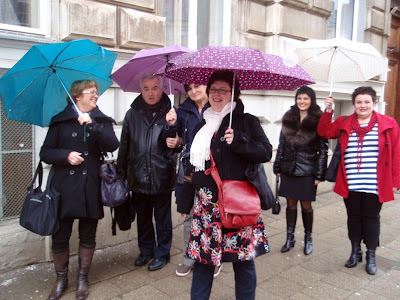
Happy DETVET delegates in Olomouc.
Loreta Staškūnienė on left

The purpose of the project – to form an international sustainable partnership in order to improve VET teachers’ competencies in education techniques – was fully reached and the results gained both at national and international levels. There were six meetings organized, each of them having it’s clear objective and outcomes defined. Before and between the meetings the work was done mostly in the national teams: dissemination, discussions, survey, validation of the chosen technique within local VET teachers, preparation the material for publishing, reporting, etc. At the international level there were carried out such activities as: exchange of methods and state of art analysis, blog design and development, creation and implementation of the investigation tools, announcing of the investigation results and recommendations, etc.
Every participating institution picked the most relevant theme for the teachers’ educational needs in approach (technique) and discussed it with teachers and students in local education environment. The pivotal outcome of the common share is mutual trust and appreciation in the partnership, the brought together competences, contribution of all partner countries disseminated at the European level.

What have we got from the partnership?
After the surveys were made in all countries, there was the clearly defined picture that our teachers need to gain more skills in use of social media, ICT tools, coaching as a method and education in entrepreneurship and innovation. It is well seen in each partners’ Conclusion chapter - different education cultures in countries and different types of institutions suggest different solutions for teachers’ qualification improvement. However, all the partners agree that they have gained from the partnership a lot of experience and know-how that encourages them to meet new challenges and promote institutional development. There are some general outcomes that partners have concluded:

  1. Much more attention should be given to the shifting paradigm. The Finnish partner (as well as other partners) raises a question of the educational use of social media – the change of culture of teaching. The education phenomena should be released from the closed classrooms and better applied to the workplaces, other surrounding environment; and teachers are supposed to be well prepared for that challenge. 
  2. Higher vocational education and training must be developed, and be maintained more in cooperation with companies and working life. 
  3. Not only pedagogic development is needed but also development of networks (working in teams, coached by a professional trainer) in order to gain efficiency in education and training. 

Without the international partnership there wouldn’t be such an effective outcome achieved –new ideas and well applied practice under different circumstances ¬– that brought a lot of creativity and new know-how into our institutions.

Having the chance, I would like to thank all the partners that they were really dedicated to the DETVET project and we – all together – have had great time!!!

Loreta Staškūnienė
The author is the Project Manager of the DETVET Project

Meet our blog readers

This blog opened at the beginning of December 2009.
Who were the readers of this blog?
Please find the statistics here

Tuesday, 4 October 2011

Read the DETVET book


What is the book about?

DETVET METHODOLOGY FRAMEWORK is a place where the DETVET (Development of Educational Techniques for Vocational Education and Training) project partners have decided to summarize all the experience and findings from the project. They consist of the parts represented by the six participating countries: Czech Republic, Denmark, Finland, Italy, Lithuania and Sweden that are laid by the alphabetical order.

Each country has summarized their project activities and ideas in four articles that show to what extent the partners have approached the project aims. The themes of the articles are:

  • VET system in a country,
  • The educational technique (approach, method) brought into the partnership by each country,
  • Results from the survey received by the questionnaire (the questionnaire – in Annex 1),
  • Conclusions.

Download the book (Adobe Reader 2MB)

Loreta Staškūnienė

Friday, 27 May 2011

Last DETVET meeting in Tampere

You can find a similar family photo on the first port of this blog:
It was from the first meeting in Klaipeda 1½ years ago.

 The last DETVET-project meeting took place in Tampere yesterday and today. We have been busy making the last decisions and preparing the project book and final report.

 The meeting took place in the old Cotton mill Finlayson, the home of TAMK Art and Media programmes.

DETVET participants and the biggest steam engine in Noric countries

We also made a Finlayson tour which introduced the Textile Museum and the Steam Engine Museum.

The roof topgarden of Art and Media
We will be soon back with a more detailed report of the meeting and project results.
|||

Sunday, 20 February 2011

DETVET at TAMK Learning Environment Conference


DETVET-project was present at the New Learning Environments Conference on February 10th at Tampere University of Applied Sciences (TAMK).

The conference with 700 participants was composed of a plenary and parallel sessions, demonstrations and workshops dealing with new solutions and environments of education and learning with the internet generation.

DETVET-project board member Cai Melakoski introduced in his presentation "Blogs and Wikis as learning platforms" materials produced by the TAMK team of the DETVET project.

Friday, 28 January 2011

DETVET Olomouc

DETVET partners discuss their experiences of the project in Olomouc, Czech Republic.

Monday, 17 January 2011

Czech VET questionnaire

The Czech part of the VET questionnaire
The Czech part of the VET questionnaire was set up at the Institute of Education and Social Studies, Palacký University in Olomouc.

19 VET teachers at the Institute filled in the questionnaires with the questions about andragogue techniques, coaching, entrepreneurship and innovation, distance form of learning and self- study, social media and web 2.0 tools, and ICT tools for learning and networking.

The profiles of the Czech respondents are :
- they teach social sciences, social psychology, IT and communication, pedagogical sciences
- 18 of them have a background with vocational training and a pedagogical education
- 17 of them have a university-master degree
- 5% have been working as VET teachers for 1 year
- 47% up to 5 years of practice
- 16% up to 10 years of practice
- 32% more than 10 years of practice
- about 11% are male
- about 89% are female
The most remarkable results and figures from the Czech part of the questionnaire are:
2.1
- nearly 53% knows methods or other means to define learning needs but they don´t use them
- more than 68% use means for monitoring of a course quality – which is surprising !
- everybody knows Activating methods in realization of a study programme
2.2
- 58% develop individual action plans with their students based on the study plan
- it´s very common to have individual discussions with the students to follow up their
results and progress
- 68% of the respondents use Problem Based Learning and Case methodology
2.3
- 100% use different methods of stimulation to motivate and encourage the potential of the students, even 42% use them frequently !
- everybody knows about E-portfolio but 42% don´t use it
- on the other hand 37% use E-portfolio in their work very often
- the same number of respondents either use tools for creating ideas or don´t know them
- 74% have no experience with cross professional/cultural innovation courses !
- the same number don´t know anything about participating in competitions
but there are few who want to learn it !
- more than 73% teach core skills in marketing and business planning
- 1/2 of respondents want to learn how to promote competencies for co-responsibility
or co-employment
- about 2/3 of respondents would like to have innovation classes or courses
- nobody uses external contact(mentoring or coaching related to business)
but more than 1/2 want to learn it !
2.4
- more than 84% use self-study or distance texts
- 74% don´t know about off-line correspondence or off-line phone
- more than 1/2 use on-line e-mails, there are only few who don´t know about it
- 3/4 of respondents use Learning Management System, a half of them very often
- more than 1/2 use tutorial in groups
2.5
- 1/2 knows some of the blogs and uses them
- 1/2 knows they exist but they don´t use them
- only 1 respondent wants to learn LeMill
- more than one half don´t know anything about Twitter !
2.6
- everybody uses e-mail and word processor, more than a half uses them very often
- 100% knows Power point presentations but 1/2 don´t use them !
- 3/4 of respondents don´t use Smartboards even if they are available !
- a pretty big number want to learn photo and sound editor + web conferencing !
- more than 1/2 don ´t use E-portfolio, only 2 respondents want to learn it
At the last question the respondents choose an area of education approach to improve - the
Czech respondents are interested in the two areas of Coaching and Social media + Web.
They show the least interest in the area of Andragogue´s practice.
The most surprising answers
The questionnaire has pointed out the fact that most of questioned respondents were women as itś usual even at the Academic field.
Surprisingly big number of respondents at least have heard of different blogs although they don´t use them but they would like to know it.
Aproximately half of respondents use techniques based on coaching but there are a lot of them who want to learn much more about Problem Based Learning or individual action plans.